
Beyond the Tumour: Mapping Systemic Physiological Change During Breast Cancer Treatment
Breast cancer treatment extends far beyond the tumour itself. Drawing from my experience as a medical scribe, this article explores how systemic physiological changes remain underrepresented within current clinical workflows, and how advances in multimodal data integration and artificial intelligence may help bridge this gap.
Scribe Workflow and System Inefficiency
As a medical scribe, I worked within clinical environments alongside oncologic surgeons, multidisciplinary teams, and patients. Managing electronic health records (EHR), a clear structural gap became apparent in how patient data was interpreted during breast cancer care. The gap was not a lack of data, but limitations in integrating baseline patient information with longitudinal physiological changes that occur throughout treatment.
Modern electronic health records (EHR) and clinical workflows are heavily optimized for vertical targets: localized tumour geometry, surgical margin clearance, and immediate hormone-receptor statuses (Estrogen, Progesterone, HER2, BRCA).
However, patients often present with a wide range of medical concerns alongside their oncologic diagnoses. A patient’s overall medical record profile may encompass systemic biomarkers and diagnostic details, including markers of metabolic and neurobehavioral regulation, and histories of musculoskeletal and orthopaedic conditions, as well as current or prior diseases, diagnoses, and medical interventions.
Despite a multidisciplinary approach to care, important relationships between oncologic treatment, systemic biomarker regulation, and musculoskeletal health may remain computationally under-integrated within current clinical systems.
The software holds the data, but integration into clinically actionable synthesis remains limited.
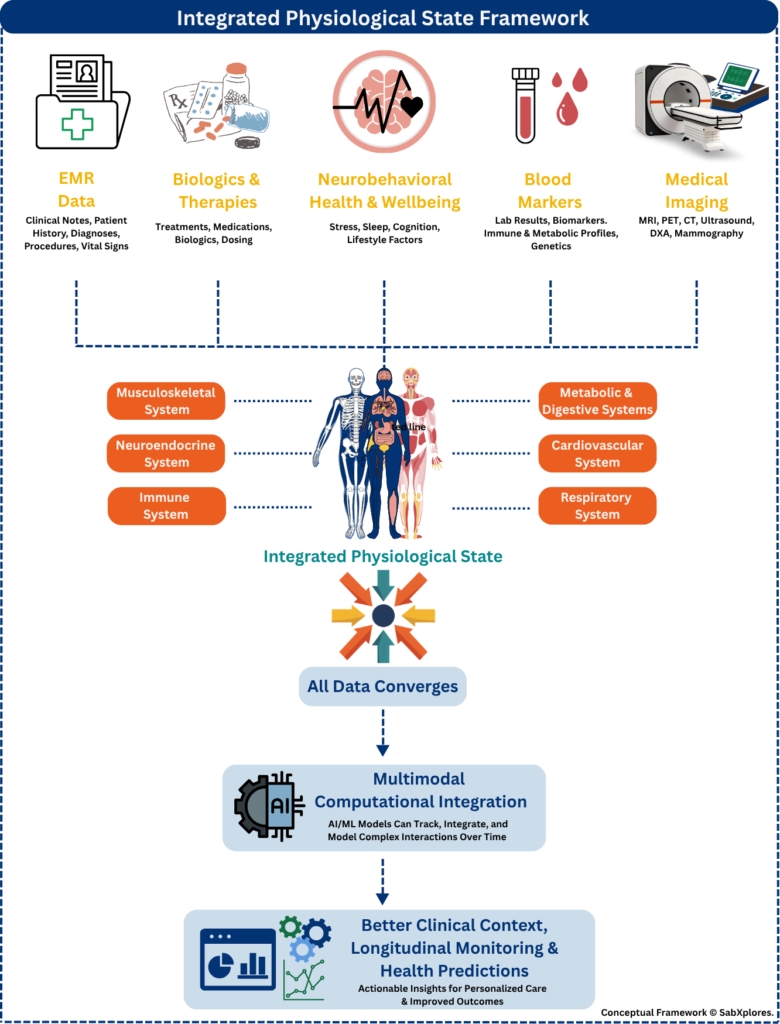
EHR systems successfully document what is happening to a patient across time, specialties and clinical encounters, yet they rarely synthesise these data into a unified physiological picture. A patient receiving treatment may experience simultaneous changes in metabolic, neurobehavioral, and functional capacity, which in turn may influence treatment tolerance, surgical recovery, and overall clinical outcomes.
The Mechanistic Pathways
Oncologic treatment and intensive breast cancer interventions trigger a cascade of secondary physiological stress. These effects can alter systemic biochemistry, disrupting metabolic regulation and influencing recovery trajectories.
Examples of these interconnected physiological changes include:
Cortisol-Mediated Immune Modulation
Chronic psychological stress and depressive symptoms are associated with activation of the hypothalamic-pituitary-adrenal (HPA) axis and sympathetic nervous system (SNS), which can lead to cortisol elevation and immune dysregulation. These changes have been associated with immune dysregulation, altered inflammatory signalling, and reduced natural killer (NK) cell cytotoxicity, which may be associated with tumour-promoting conditions [1,2]. Consequently, these stress-related physiological changes may negatively influence the body’s capacity for tissue repair and recovery.
Neuroendocrine Dysregulation and Cancer Cachexia
Breast cancer treatments, including chemotherapy and radiation, may influence not only tumour biology but also broader systemic metabolic and musculoskeletal health. Chronic stress is associated with inflammatory and metabolic changes that may overlap with processes involved in cancer cachexia.
Cancer cachexia, or rapid muscle wasting, is characterised by progressive weakness and bone loss, involving complex interactions between tumour-derived factors and dysregulated muscle (myokines) and bone (osteokines) signalling [3]. These changes are associated with fatigue and reduced physical capacity in breast cancer patients, affecting quality of life and recovery outcomes [4].
The Gaps in Clinical Monitoring
Multimodal patient data may be available to physicians, with comprehensive patient charts including detailed descriptions of patient history and medical diagnoses. However, there remains a gap between data that are passively viewable by clinicians and data that are actively integrated into meaningful clinical insight through computational analysis.
Whilst scribing and assisting during real-time chart reviews, limitations in clinical data integration become apparent at the point of care. Surgical and medical oncologists must simultaneously manage the immediate demands of cancer treatment while considering a patient’s broader medical history and physiological status. Naturally, immediate clinical priorities take precedence during patient consultations.
Yet software has the potential to move beyond passive documentation by identifying relationships across multiple physiological systems, by correlating and highlighting underlying interconnected mechanisms that may be impacting a patient’s progress. For example, most current EHR systems are not designed to cross-reference a patient’s declining muscle mass with concurrent physiological changes to generate predictive, real-time alerts indicating metabolic decline.
While common in breast cancer patients and considered clinically meaningful, muscle health, body composition, and musculoskeletal-related outcomes are not routinely monitored alongside oncologic treatment [2]. EHR systems do not yet consistently succeed in integrating systemic decline alongside treatment data.
The Computational Horizon
Modern electronic health record (EHR) systems have evolved, increasingly incorporating artificial intelligence (AI) pilots, multimodal models, and predictive algorithms, reflecting early steps toward more integrative clinical systems. However, these tools remain mostly siloed in practice, lacking longitudinal synthesis, contextual interpretation of disease trajectories, and the infrastructure required for system-wide physiological reasoning [5].
Although modern healthcare data is multimodal, meaningful integration across imaging, biomarkers, clinical observations, and longitudinal health records remains limited. Emerging multimodal deep learning architectures demonstrate that such integration is increasingly feasible. Hypernetwork-based models, for example, show how imaging can be dynamically combined with structured EHR data to enable more personalized prediction [6].
The future of digital oncology is increasingly moving from simply storing patient data to understanding the relationships within it. Together, these findings highlight the growing need for integration across modalities, in which synthesis of multisystem physiological data and real-time analysis can enable a more comprehensive understanding of a patient’s overall health. Such integration may have significant implications for clinical decision-making, treatment planning, and patient recovery outcomes.
My time as a medical scribe changed my perspective on how clinical data can be interpreted. It is not only important to document a patient’s past, present, and evolving clinical picture, but also to understand how seemingly independent physiological changes interact over time. As multimodal AI and data integration continue to advance, a significant opportunity exists to help clinicians uncover these relationships in ways that current clinical workflows cannot, potentially supporting more comprehensive and personalized patient care.
References
- Liu Y, Tian S, Ning B, Huang T, Li Y, Wei Y. Stress and cancer: the mechanisms of immune dysregulation and management. Front Immunol. 2022;13:1032294. doi: 10.3389/fimmu.2022.1032294
- Zhong P, Li X, Li J. Mechanisms, assessment, and exercise interventions for skeletal muscle dysfunction post-chemotherapy in breast cancer: from inflammatory factors to clinical practice. Front Oncol. 2025;15:1551561. doi: 10.3389/fonc.2025.1551561
- Pin F, Bonewald LF, Bonetto A. Role of myokines and osteokines in cancer cachexia. Exp Biol Med (Maywood).2021;246(19):2118–2127. doi: 10.1177/15353702211009213
- Mallard J, Hucteau E, Hureau TJ, Pagano AF. Skeletal muscle deconditioning in breast cancer patients undergoing chemotherapy: current knowledge and insights from other cancers. Front Cell Dev Biol. 2021;9:719643. doi: 10.3389/fcell.2021.719643
- Post AR, Burningham Z, Halwani AS. Electronic health record data in cancer learning health systems: challenges and opportunities. JCO Clin Cancer Inform. 2022;6:e2100158. doi: 10.1200/CCI.21.00158
- Duenias D, Nichyporuk B, Arbel T, Riklin Raviv T. Hyperfusion: a hypernetwork approach to multimodal integration of tabular and medical imaging data for predictive modeling. Med Image Anal. 2025;102:103503. doi: 10.1016/j.media.2025.103503
Written by Sabrina Sangha
sabXplores