
From Data to Intervention: The Missing Link Between Wearables and Implants
From tracking the body to rebuilding it, wearables and implants sit on opposite ends of the same spectrum.
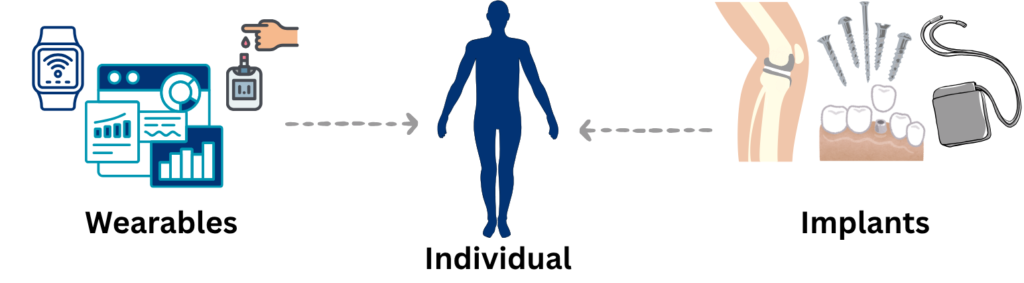
On one end, wearables observe. They track how we live by gathering information on sleep, movement, heart rate, oxygen levels, and even hormonal cycles. They generate continuous data about behavior and how we respond to the world around us.
On the other end, structural implants intervene. They are engineered to restore function, reduce pain, and replace failing joints, increasingly tailored to the individual through advanced imaging and 3D modeling.
Both are built on precision and data. Both aim to support human function. Yet they rarely speak to each other.
Wearables observe.
Implants intervene.
So where is the connection?
We measure more data than ever, yet we still lack a cohesive understanding of the individual.
The gap isn’t just technology. It’s understanding the individual in between.
Human function is shaped by more than anatomy alone. We vary dramatically in how we adapt, recover, respond to stress, and maintain movement and functional capacity over time. These differences are shaped by behaviour, environment, activity levels, biological predispositions, and the interaction between systems.
Through my work in musculoskeletal imaging and clinical research, I’ve seen how imaging informs surgical decisions, how implant positioning affects long-term outcomes, and how muscle quality influences recovery.
But I’ve also seen the disconnect.
We are highly advanced in capturing structure and intervening surgically. We are increasingly capable of tracking behaviour in real-world settings. But these systems remain separate.
Clinical decisions are still largely made without incorporating continuous, real-world data.
And wearable data rarely informs how we plan or evaluate interventions.
The challenge is not simply collecting better data, but building systems that can translate data into decisions across the full patient journey.
So the questions that come to mind are:
→ How do we move from fragmented data to meaningful, individualized understanding?
→ How do we integrate imaging, biology, and behavior into clinical decision-making?
→ How do we use real-world data to guide treatment, recovery, and long-term outcomes?
The body does not operate in silos. Yet our systems for understanding, measuring, and treating it still do.
Bridging the gap between observation and intervention may define the next phase of healthcare innovation.
Written by Sabrina Sangha
sabXplores